$10K/mo
Evelina Guilherme
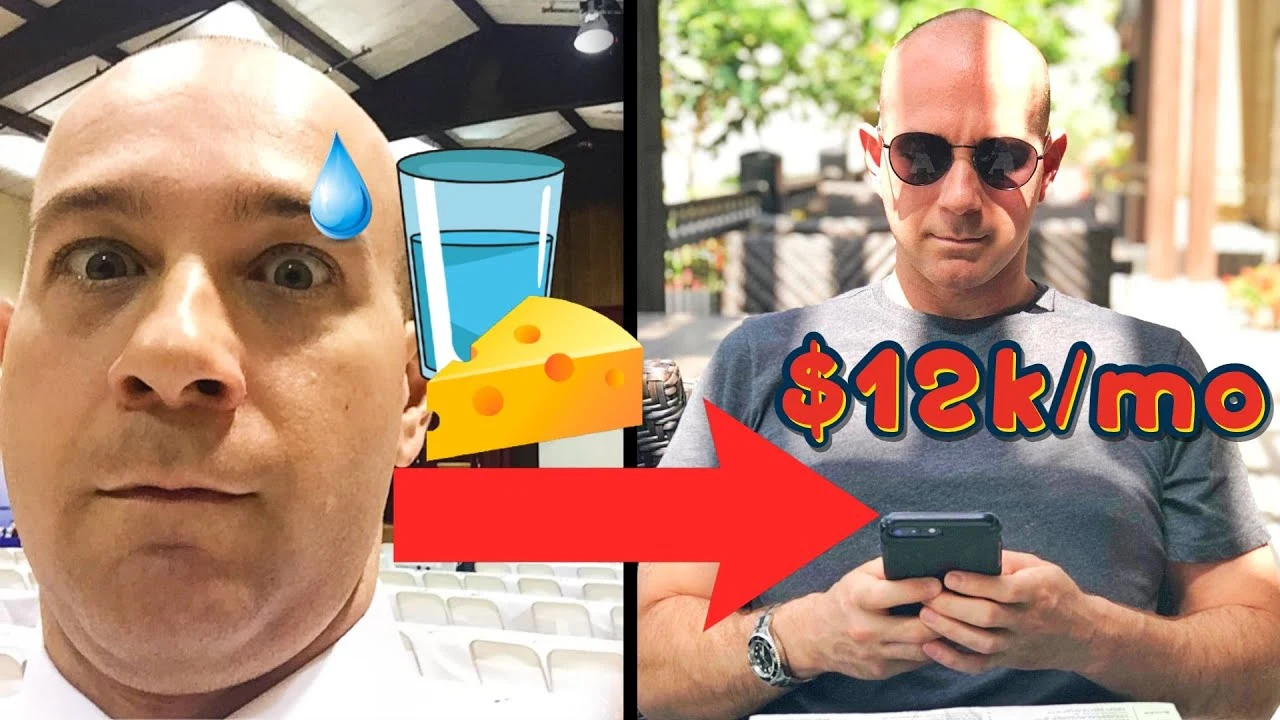
Built to $10K a month on the side of her Dow Jones job, then went full-time on it. Her favourite perk: "Now I can approve my own time off."
For marketers in golden handcuffs and copywriters who can already write.
I've taught people to land clients since 2018, and since early 2026 I've taught them to become creative strategists for brands running Meta ads, so one company's calendar invite stops being the only thing standing between you and the house deposit.
Sean Ferres has 4.8 out of 5 on Trustpilot from 113 reviews, and 94% of them are five-star. Read them on Trustpilot.
Updated 24 November 2026
Real students, real numbers
Built to $10K a month on the side of her Dow Jones job, then went full-time on it. Her favourite perk: "Now I can approve my own time off."
Went from about €2,000 a month in a Luxembourg office to creative strategist for nine-figure brands, with a $50K month in 2025.
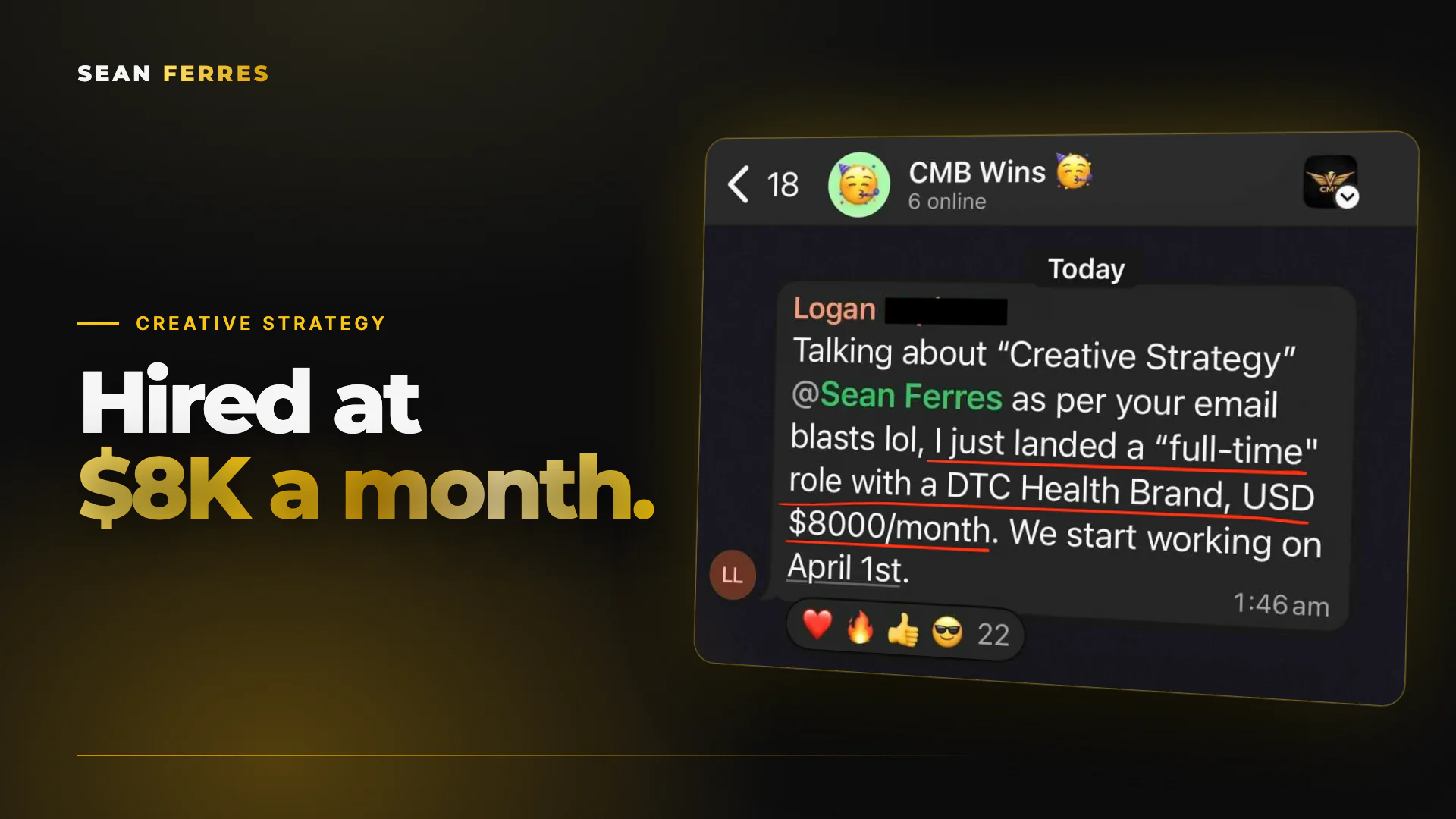
Read the Q&A →Had been copywriting for 6 years at about $5K a month. In 30 days she signed $20K a month in new clients.
These are some of our best results, not typical ones. What you make depends on your skills, your effort and the market. Every result
Nothing good has ever happened in a meeting called “Quick sync.”
Fifteen minutes. No agenda. Someone from HR you’ve never met, marked “optional,” which is the most threatening word in the English language after “per my last email.”
It’s layoff season, and you know exactly the invite I mean. (You’ve checked your calendar for one twice today. Don’t lie to me.)
Your company sent the “restructuring” email on a Thursday. By Friday, someone two desks over had cleared out their drawer. On Monday, everyone stood around the coffee machine treating the empty chair like a hot-desking initiative.
You’ve still got a good job. You just open your calendar every Monday like it’s a pregnancy test.
You’re not the only one running the numbers in a toilet cubicle. One of my students told my team, word for word: “It’s layoff season and my company has been really bad this year.”
Another said he’d rather take the chance than stay “a well-paid slave.” Smart people with good salaries and very nice lanyards, both done handing all of their judgment to one employer who could switch it off with a calendar invite.
Because right now your whole income lives in one spreadsheet on someone else’s laptop. It’s called “Q3_headcount_FINAL_v7_ACTUALLY_FINAL.xlsx”, you’ve never seen it, and you’re row 214.
That’s a shit way to find out what you’re worth.
Evelina Guilherme spent 10+ years in finance and marketing roles. She built creative strategy income to $10K a month on the side of her Dow Jones job, then went full-time on it. Her favourite perk:
“Now I can approve my own time off.”
Try getting that sentence past a leave request form.
Someone who still makes ads that sell, has a long list of named students getting paid to do it, and teaches you to land clients as well as make ads. A great ad-maker who has never taught is a gamble. A teacher whose last ad ran before Andromeda is teaching history, with worse slides.
Do I tick all three? Of course I’m going to say yes. I’m the guy on the box.
So skip my word and check the paperwork.
Ads that sell: I’ve been in direct response since 2017, I still write my own ad scripts, and my own offers have done about $7 million in sales, most of it from Facebook ads.
Named students: 88 of mine have cracked six, seven, or even eight figures a year, and dozens of them explain how in full interviews on YouTube. Go watch one at 1.5x and try to catch them lying. You’ll run out of popcorn first.
Clients: I built the whole business on this one, starting in 2018, because getting clients is exactly where copywriters kept getting stuck. Creative strategy skill with no client is a pilot’s licence with no plane. Lovely certificate, great uniform, and you’re still catching the bus.
Yes, and you might be the best-placed person reading this.
You already know funnels. You’ve watched six people in a conference room pick a font for 40 minutes while the ad itself got waved through. You’ve probably written half the ads your agency took the credit for. (You did. Don’t be modest. It doesn’t suit you.)
Creative strategy is that same brain, with your name on the result and on the invoice.
A brand will pay $5K to $12K a month to someone who can carry its ads from research to results.
Two of those is a full corporate marketing salary for plenty of people, earned on your own calendar, with no one asking you to “circle back” ever again. (If you just winced at “circle back”, welcome. You’re my people.)
Why now? Meta’s Andromeda update made brands need far more ads than they have people to make them, and right now that gap is the size of a garage door. It won’t stay that size, and the people who walk through first get first pick of the brands.
Yes, a big chunk of it, and if money’s tight I’d tell you to start there. Read a brand’s reviews, study the Ad Library, write 25 hooks for one product and make some statics.
My blog will get you a long way: start with the 6C research system and how to turn one complaint into 25 angles.
Where people stall on their own is the feedback loop.
You make an ad, it feels good, and you have no idea whether it IS good, which is the same feeling as singing in the shower.
You send outreach and hear crickets, and you can’t tell whether the problem is the offer, the target or the message.
Then you land a call, panic, and price yourself like a uni student who’ll work for exposure and a sandwich, and not even a nice sandwich, a servo sandwich in the plastic triangle.
That’s what you pay a coach for: someone to hear the shower singing and hand you a towel before the neighbours complain.
Learn it in the order the work happens, which is the order my IMPACT system runs. Skip ahead and you’re the guy building the IKEA wardrobe with the doors on backwards, wondering why it won’t close.
Then positioning and clients: your offer, your pricing, and a way of finding brands that doesn’t involve spraying 500 cold DMs into the void and praying.
Most people learn the middle bit first because it’s the fun part, then wonder why their ads look great and sell like a wet sock. If you want the full picture of the role first, what a creative strategist does walks through it stage by stage.
If you can already write, the core skills take weeks to learn and a few months of real reps to get sharp. My program runs 10 weeks of live coaching, and you keep lifetime access to the material after that.
The better question is how long it takes to get paid for it.
Iason was on about €2,000 a month in an office in Luxembourg. He’s now creative strategist for nine-figure brands, and in 2025 he had a $50K month, which is nearly two years of the old pay landing in one go.
I’d love to tell you that’s normal. It isn’t. It’s one of the best results I’ve got, plenty of people take longer, and none of it is a promise about your timeline. What it proves is how far the skill can carry you once brands trust you with their ads.
It looks like doing the job with a coach over your shoulder, minus the coffee breath.
You learn a stage, apply it to a real brand, and get feedback on the work itself. Dial It To 11, the ad copy masterclass, takes your hooks and primary text from a 6 to an 11, and your ego from an 11 to a 6 for about a week.
Then comes the client side: positioning, the 3-page Anti-Resume, Reverse Outreach, sales calls and pricing.
Take the Anti-Resume, my favourite little grenade. It’s a sales page for yourself, with an offer up front and a list of reasons not to hire you as a pattern interrupt, then a normal CV at the back to keep HR happy. HR loves a normal CV. It’s a security blanket with bullet points.
If you’re short on time, read this post on freelancing with a full-time job before you plan your week. It finds you hours you didn’t know you had, down the back of the couch next to 20 cents and a Lego head.
Skip me if you want out of the building by Friday. Creative strategy is a skill you build beside the job and lean on once it’s paying, and the people who rush that order end up stressed, underpriced and refreshing job boards at midnight.
Skip me if you hate the idea of selling. You don’t need to be a natural salesperson, but you’ll be talking to founders, and you’ll need to say a number out loud without apologising for it. “Um, would, like, five-ish work?” is a question, and founders answer questions with “no.”
And skip me if you already run creative for a stack of brands with a team under you. You’re past learning this. You should be teaching it.
If you’re a marketer tired of making someone else rich on a salary, or a copywriter who can already write, the full roadmap is in how to become a creative strategist.
Score yourself on it and bring the box that made you swear at your laptop to the call. The ugly boxes are the quickest ones to fix.
And the next “Quick sync” in your calendar will be one you booked, with a client who pays you.
FAQ
Someone who still makes ads that sell, has a long list of named students getting paid to do it, and teaches you to land clients as well as make ads. Check all three before you hand over a cent, and check the dates.
Anything filmed before Meta's Andromeda update is a lesson in how ads used to work, which is charming in the way a fax machine is charming. Please don't learn from the fax machine.
A lot of it, yes, and I'd start there. My YouTube channel and blog cover the role, the research system, angles, hooks and the client side.
What free content can't do is look at your ads, catch the mistake you can't see, or stop you pricing your first retainer at half what the brand would have paid.
That's what coaching is for: speed, and someone checking your work before a founder does.
If you can already write persuasive copy, the core skills take weeks to learn and months of reps to get sharp. My program runs 10 weeks of live coaching with lifetime access to the material.
Getting sharp happens on real accounts, with someone telling you which of your ideas were rubbish. Several will be. That's the fun bit, and it's a lot more fun when a coach catches them than when a founder does.
No. Writing that sells is the core of the job, but marketing pros already understand buyers, funnels and numbers, and they pick it up fast.
Evelina Guilherme came from 10+ years in finance and marketing roles and built to $10K a month beside her job at Dow Jones. Turns out years of staring at spreadsheets is decent practice for staring at Ads Manager.
Yes, and that's how most of my students with day jobs do it. Calls are recorded, the work happens in focused blocks, and you build the second income before you make any decision about the first one.
It takes real hours each week, so the team will map them around your job on the call before you commit to anything. Your lunch break is about to get a lot more interesting, and a lot less sad desk salad.
No skill is bulletproof, and anyone selling you a layoff-proof vest is also selling you a timeshare.
What creative strategy gives you is a skill brands pay for directly, so your income stops hanging on one manager's budget meeting and whatever mood he woke up in.
A lot of the people who join say some version of what one buyer told us on her call: she no longer believed a nine to five was any more secure than freelancing.
No. To most people Ads Manager looks like the cockpit of a 747, and that's fine.
You learn how campaigns are structured, which numbers drive the decisions and how to spot a winner, so you can talk to media buyers and founders without bluffing. You don't need to fly the plane.
You need to know which buttons matter, and which one drops the oxygen masks.
No. You practise on real brands: small paid projects, spec work for a brand that's already spending, or swapping work with other students to build samples and reviews.
The Meta Ad Library also shows you what every brand is running and for how long, which makes it the best free research tool on the internet and easily the nosiest.
The pieces are learnable: research, angles, hooks, scripts, briefs, testing. The hard part is doing all of them every week without dropping one, then selling it at a proper price.
That's why I teach it as IMPACT, six stages in order, and why coaching makes the difference for most people. You stop guessing which piece is broken because someone points at it, usually with a slightly smug look.
The Meta Ad Library for seeing what brands run, Ads Manager for reading results, a tracking tool for attribution, and AI tools like Claude for research, drafts and static ads.
Add a doc for your angle map, a swipe file of proven winners, and editors or UGC creators for video. The tools change every few months, which is why we teach the judgment first.
A hammer's only as good as the person deciding where the nail goes.
If an agency will train you and pay you while you learn, that's a solid route, and you'll see a lot of accounts.
The catch is that you're paid as an employee and won't usually learn to find and close clients yourself, because the agency would very much prefer you didn't. Funny, that.
My program is built for people who want their own clients, their own pricing and their own calendar.
Research, the I in IMPACT. It's the dull-looking step that makes every other step work: reviews, comments, sales calls and competitors' ads, until you can describe the buyer's problem better than they can.
Then Map, Pen, Assets, Campaign and Test, and finally your own positioning and pricing. Skip research and you're writing clever hooks for a buyer you've never met, which is speed dating with a paper bag over your head.
Both. The system works for any brand running Meta ads, and my students work with e-commerce stores and with info and coaching businesses. E-commerce brands usually need the most volume, with statics, UGC and video every week.
Info brands tend to want longer ads, advertorials and funnels. You'll learn to pick a lane and price for it, so you're not the strategist who says yes to everything and sleeps on none of it.
No, though it's making a lot of average work worthless, and that's a different problem. AI can spit out 50 angles in a minute.
Someone still has to decide which five are worth a brand's money, why the winner won and what to make next week, and that call is what brands pay a strategist for. We use AI right through the program.
The deciding stays with you, and so does the invoice.
The team covers the price and plans on the call, once they've heard where you're starting, because a marketer on a corporate salary and a copywriter between clients want very different plans.
They'll also tell you if it doesn't fit right now, and the long answer on why the price isn't online is on my FAQ page.
Yes. I rebuilt the program as CMB 3.0 in early 2026, after Meta's Andromeda update changed what brands need from their ads, and the coaching runs on what's working in live accounts now.
Old material is the thing I'm most allergic to in this space. The phrase "interest stacking" makes my left eye twitch.
Book a call with my team. If it's a fit, we'll map out your next 10 weeks. If it isn't, we'll tell you straight, no pressure, no "this price expires in 4 minutes".
Keep reading