Why Your Meta Ads Bring In Cheap Leads That Never Buy (And the One Dropdown That Fixed Mine)
Cheap leads, great CTR, zero sales? Meta ads bring bad leads because you trained them to. How to fix the audience, the offer, the pixel and the copy.

Why do your Meta ads bring in cheap leads that never buy? Because you trained Meta to find them. Count every cheap form fill as a win and Meta goes and finds you more of the same.
So if your Meta ads are making you want to tear your hair out and take a bath with an electric eel, I almost guarantee it’s one of three things: the wrong offer, the wrong person, or a pixel you’ve trained to find more of the wrong person.
People love to complicate the hell out of advertising so they can sell you their shitty agency services. It really is just those three.
Here’s how it usually goes. You launch a new ad on Monday. By Tuesday it’s pulling a 3% click-through rate, leads are coming in at $12 a pop and the comments are full of people saying, “This is exactly what I need.” So you crank the budget.
Then the sales team starts calling, and the whole thing falls apart.
90% of them don’t answer. The ones who do thought it was free. One guy sits through a 40-minute call, asks 17 questions, says he needs to talk to his wife, then smoke-bombs the second the payment link arrives.
Naturally, the creative gets dragged into court. The copywriter changes the hook, the editor adds bigger captions and faster cuts, and the media buyer starts poking settings that were perfectly fine.
A week later you’ve got 20 new ads bringing in the same tyre kickers.
Your highest-clicked Meta ad might actually be the worst-performing ad in the account, because it can win every metric inside Ads Manager while filling your CRM with people who are never going to buy.
At some point you have to ask whether attention was ever the problem.
Why do Meta ads keep bringing in bad leads?
Meta can’t hear the sales call. It has no idea the lead ignored six follow-ups or vanished when the invoice arrived, unless you send that back from your CRM. It works with the event you told it to optimise for.
If that event is a cheap form submission, Meta gets very, very good at finding people who submit forms cheaply. The internet has plenty of those. Getting them to buy is where the wheels come off.

Meta’s own numbers back this up.
Basically, when you connect your CRM, Meta finally knows which leads are actually worth finding.
By the time I filmed this, I’d been banging on about Andromeda for a year while the rest of the industry was still asleep at the wheel. It’s the engine at the front of Meta’s ad system, and it decides which of your ads even gets a shot.

Then everyone opens the CRM on Monday morning and acts shocked when the leads are bad. Which is why an ad that sells starts long before you touch the copy.
How close is your audience to buying?
Our good old pal Eugene Schwartz mapped this as the five stages of awareness. Great framework, a bit abstract. I much prefer Chet Holmes’s stadium pitch.

The 7% have watched other copywriters cash in on creative strategy and they’re curious. The first 30% have been living under a rock and missed the feeding frenzy.
The next 30% don’t think they’re interested, because they’re clutching their cute little $500 email sequence for dear life and refuse to accept the money has moved on.
And the bottom 30% know they’re not interested: the dumbasses with their heads in the sand, gaslighting themselves that this isn’t the most brain-dead obvious move for copywriters since the invention of the literal internet.
Squash it into two buckets: the in-market people looking to buy, and the people who need convincing. For direct response, which is the only kind of ads we run around here, you want to live near the top.
Leave the completely unaware to Apple. They can spend years and billions teaching the world to want something it didn’t know existed. Your client isn’t Apple. They need action now.
Why does a $200,000 tax bill explain your funnel?
Take a tax accountant. Someone’s already looking to hire a new one. Hi, it’s me. I’m right here.
The good old Communist Republic of Australia sent me a $200,000 tax bill the month before I filmed this, and that’s not really my idea of a good time. So for me, your ad can be one line:
"Need a new tax accountant? We'll lower your tax bill, guaranteed, or you don't pay."
Home run, slam dunk offer. Where do I sign? Literally take my money, dude.
Now take someone who’s never once thought about hiring a tax accountant. Before you can sell them anything, they have to agree to three things.
- 1They're overpayingThey're spending more on tax than they need to.
- 2It's legal to fixThey can legally bring the bill down.
- 3They need a proThey won't manage it on their own.
We call this agreement engineering, and it drives every winning ad, VSL and webinar. Work out the beliefs they need, then knock them down one at a time like dominoes, in order, all the way to the sale.
Shifting three beliefs in a 30-second ad is brutal, so a less aware audience needs an education step: a VSL, a sales page, a webinar. Send them straight to an application page and it ain’t going to convert, buddy.
Where do you find the words that sell?
Talk to your customers. It’s not rocket science. Get your buyers to fill in a survey (incentivise it if you have to), transcribe your sales calls, read your reviews, the good and the bad.
Throw it all into Claude and ask for the common patterns, the objections and the exact language your actual buyers use. Your buyers, not random scrubs on Reddit with nothing better to do than argue in forums all day. Literally the cesspool of the internet.
Describe their reality better than they can, and they'll assume you have the solution.
That’s the number one law of sales. Not very logical, but it’s a million percent true.
And because Andromeda effectively removed targeting, the copy, the script and the creative are the targeting now. Even the face matters: advertise to plumbers and they’ll trust a plumber who gets their world over some guy in a suit behind a desk.
What is pixel conditioning?
Once you’ve found the person ready to buy, the offer has one job: give them a reason to move now. When it lands, they click, apply, book or buy, hit the confirmation page, and Meta gets told.
Then the pixel goes off to find more people like them, so watch those leads like a hawk before Meta’s in too deep and there’s no way out.

That’s pixel conditioning. Every time you optimise for a lead, a call or a sale, you’re telling Meta, “This person counts as a win. Find me more people like them.”
Say you run a high-ticket book-a-call funnel and a pile of completely unqualified applicants comes through. Guilty as charged. They fill in the application, hit the thank-you page and fire the exact same conversion event as a great lead.
Meta can’t see the difference. It only knows cost per result, so it thinks it’s killing it: “Cheap ass leads, let’s go, spin, spin, spin, spin, spin.”
You fed the pixel tyre kickers. Now it’s building you a tyre-kicker pipeline. Congratulations.
Most advertisers don’t take ownership. They blame the trillion-dollar company with the cracked-out, alien-level tech and announce, “Oh, my ads don’t work.”
Maybe you just suck.
How do you use friction to fix lead quality?
You train the algorithm, and the lever you pull is friction: how hard you make it for someone to do the thing you want.
Leads too expensive
- Remove friction
- A simple opt-in box
- First name and email, done
Plenty of leads, terrible quality
- Add friction
- A phone number field, more form fields, heavier qualification copy
- Delay the button so they have to watch the VSL first

The one dropdown that made my webinars profitable
My webinar registration page brought in exactly the right people for my first two webinars. I was stoked.
Then the pixel wandered off to Timbuktu and started bringing in the most whack-ass random NPCs, bizop non-copywriters who wanted to make $10K in 10 minutes doing nothing. The webinar absolutely bombed, because the room was full of donkeys.
So I added one dropdown to the opt-in form. One field: are you a working copywriter? Yes or no.
Picks no
- Lands on the get-[redacted] page
- The exact same page, minus the pixel
- Meta never finds out they existed
Picks yes
- Lands on the normal confirmation page
- The pixel fires and reports a lead
- Meta goes and finds more copywriters
Meta can’t see the no’s, so it can’t count them in the results column. It only optimises around the people who said yes.
Sounds trivial. That single change took us from barely breaking even on every cold-traffic webinar, or even losing money, to our very first profitable cold-traffic webinars, ones we can actually scale. Don’t sleep on this.
How do you write Meta ads now that Andromeda decides who sees them?
The last lever is the one copywriters actually get paid for: the words Meta pushes out.
This is why I keep saying that if you’re a copywriter, you’re already 80% of a creative strategist. But because you call yourself a copywriter, you’re earning about 30% of what you should be.

Listen. Andromeda doesn’t care that you changed your shirt and moved the camera into the kitchen. That’s the same ad wearing a fake moustache.
The old playbook was one winning script with three to five hooks bolted on the front. Those days are dead. What Meta wants now is completely different messages, because Andromeda is a hungry hippo.
Take a weight loss offer. Super blue ocean, totally not a competitive space at all. One person wants to feel confident with their shirt off. One just got their ass dumped.
Another wants to live longer. Someone else wants back the part of their marriage that disappeared when they stopped feeling good about themselves.

And Andromeda can tell those people apart, because it knows absolutely everything about everyone. Ever chatted to a mate about something random and then seen ads for it all week? Yep.
In total, we collected more than 52,000 unique attributes that Facebook has used to classify users.
ProPublica, December 2016
And that was years before Andromeda, whose whole job is pairing the exact right ad with the exact right person, with laser precision.
That’s why it now wants five to 10 times more ads than before, instead of 20 versions of one script with the furniture moved around. And that’s exactly what gave birth to the creative strategist.
Brands need someone who can find the angles and make that many ads, and they’re paying $5K to $12K a month for it. It’s a feeding frenzy out there.
What does the hook actually need to do?
A strong angle only gets you in the door. The ad still has to survive about 1.8 seconds, the average view before people decide to keep watching or scroll.
Their thumb is hovering over the eject button before you’ve finished your first sentence, begging for a reason to go watch a cat video. Cold traffic is ruthless. You could die in a fire and they’d keep scrolling.
So the hook’s job is to plant the next question in their head.
Hooks that open a question
- Something happened. How?
- Someone got a result. What did they actually do, and will it work for me?
- There's a mistake costing me money. Which one?
The brain hates an open loop, so that unanswered question buys you a few more seconds. Then it’s on the idea itself, because there is no editing trick that can perform CPR on a dead idea. (I’ve got a whole post on Meta ad hooks that work.)
How should the body of the ad flow?
Once they’ve stopped scrolling, the body walks them through your sales argument without holes big enough to fall out of. The order that’s worked best for me:
- 1ProblemMake it feel real: what it costs, what keeps happening, what gets worse if it's left alone.
- 2TransformationHint at the way out. Dump all of it and you've made a tutorial.
- 3ProofProof is your god in copywriting.
- 4ObjectionsAnswer each one the moment it pops into their head.
- 5UrgencyA real reason to act now.
On proof: I once sent traffic to two versions of the exact same sales page. Both had the promise, the offer and the guarantee. One had every screenshot, testimonial and result stripped out.
Proof stripped out
- $800 in ads
- A $197 offer
- Zero sales
Proof left in
- Same traffic, switched over
- First sale within 2 hours
- "Trust me, bro" became receipts they can check
On objections, Agora, the billion-dollar copywriting giant, calls it copyboarding: make the claim, predict the doubt it triggers, kill it before you move on. Answer it three sentences later and they’ve already mentally checked out.
And skip the urgency at your peril. Without a real reason to move, they save the ad, park it in a tab and forget it exists 10 seconds later.
Where does the ad fit in the bigger machine?
The ad is one piece of a much bigger system. Around it sits finding the angles the market is dying for, producing and testing the ads, reading the data, and getting paid a juicy five-figure retainer as the strategist behind the machine.
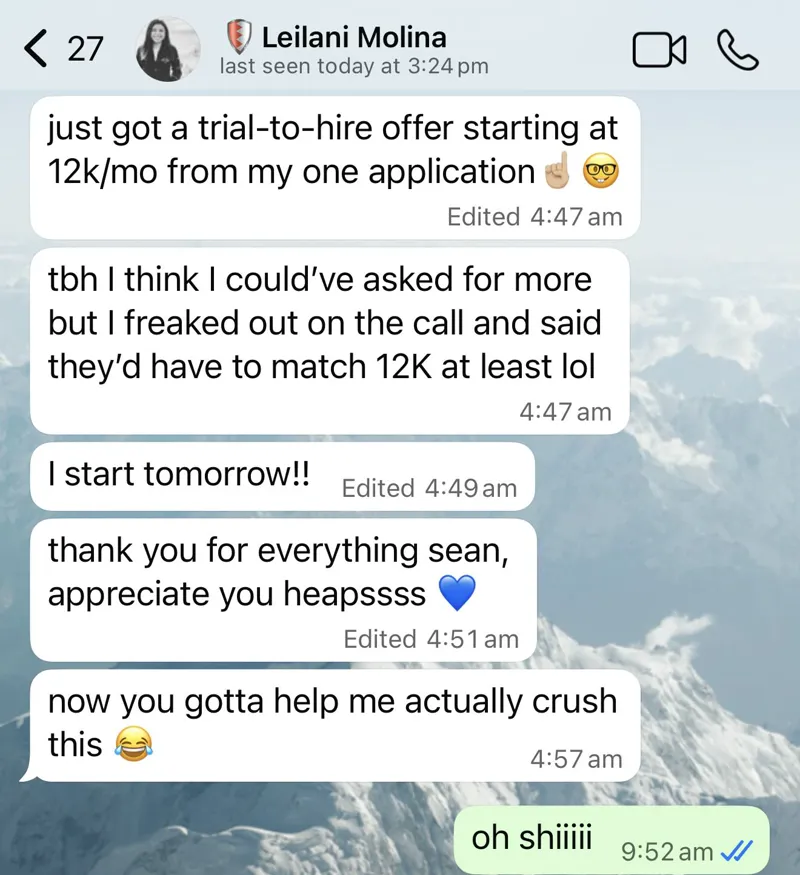
And getting hired in the first place. Leilani had no ads experience and no portfolio. Her Anti-Resume landed her a $12K a month trial-to-hire offer on the very first application she ever sent. Literally insane. Can’t make that up.
Every piece of it, and a way to score yourself on each so you know exactly what to fix first, is in the 0 to $20K a month creative strategist roadmap. Grab a pen.
And if you’d rather fix your weakest piece with me, apply here.
Meta will find you more of whoever you reward. Make sure it’s someone you’d actually want on the phone.
Questions people ask about this
Why are my Meta ads getting bad leads?
Usually because the campaign is optimising for a cheap conversion event, like a form submission, and every unqualified person who fills in the form gets reported to Meta as a win. Meta then goes and finds more people like them. Fix it by adding friction, qualifying leads and only firing the pixel for the people you actually want.
What is pixel conditioning?
It's deliberately choosing which people Meta counts as a conversion so it learns to find more of the right ones. Sean's example: a yes/no question on a webinar opt-in. Yes goes to the normal thank-you page with the pixel; no goes to an identical page without it, so Meta never learns from unqualified sign-ups.
How do you add friction to a lead form?
Add a phone number field, more qualifying questions, heavier qualification copy, or delay the button on the page so people have to watch the video first. Each one makes it a little harder to convert, so only serious people get through.
How should you structure the body of a Meta ad?
Make the problem feel real, hint at the transformation without turning it into a tutorial, bring in proof, answer each objection the moment it appears, then give a genuine reason to act now.
Does connecting your CRM to Meta improve lead quality?
Yes, according to Meta's own numbers. Advertisers who connected their CRM and optimised for conversion leads saw a 15% lower cost per quality lead and a 44% higher rate of leads becoming quality leads, compared with campaigns optimised for lead volume.
Want my team to help you do this with real clients?
Book a call. If it's a fit, we'll show you how the next 10 weeks go. If it isn't, we'll say so.
Work with me
Sean Ferres
Sean has worked in direct response since 2017 and founded CMB (Copy Millions Blueprint) in 2018. 88 of his students have cracked six, seven, or even eight figures a year. He now teaches copywriters and marketers how to become creative strategists.
More about Sean →Read the video transcript (lightly trimmed)
If your Meta Ads are making you want to tear your hair out and take a bath with an electric eel, I almost guarantee it is one of these three things and I'll prove it right now. People love to complicate the hell out of advertising so they can sell you their shitty agency services. But, as someone who spent and made millions on Meta Ads, I promise success with ads comes down to only three things: making the right offer to the right person [music] and training your pixel to find more of them. See, your highest clicked Meta Ad might actually be the worst performing ad in the account because it can win every metric inside Ads Manager while filling your CRM with brokies who are never going to buy.
You launch a new ad on Monday, by Tuesday it's pulling a 3% click-through rate. Leads are coming in at 12 bucks. The comments are all full of people saying, "This is exactly what I need." So, you increase the budget, then the sales team starts calling the leads, and the whole thing goes to [ __ ] 90% don't answer. The ones who do thought the offer was free. One guy sits through a 40-minute sales call, asks 17 questions, says he needs to talk to his wife, and then smoke bombs the second the payment link arrives. Naturally, the creative gets dragged into court.
The copywriter changes the hook. The video editor adds bigger captions and faster cuts, and the media buyer starts touching settings that were perfectly fine. A week later, you have 20 new ads bringing in the same tire kickers. At some point, you have to ask whether attention was ever the problem. What if the ad is doing exactly what you trained Meta to do? Understand, Meta can't hear the sales call. It doesn't know the lead ignored six follow-up messages or vanished when the invoice arrived unless you send that information back from your CRM. Meta works with the event you told it to optimize for.
If that event is a cheap form submission, Meta will get very good at finding people who submit forms cheaply. The internet has plenty of those. Getting them to buy is where the wheels start to come off. And Meta's own numbers back this up. Advertisers who connected their CRM and optimized for conversion [music] leads saw a 15% lower cost per quality lead and a 44% increase in the rate of leads becoming quality leads compared with campaigns optimized for lead volume. Basically, when you connect your CRM, Meta finally knows which leads are actually worth finding. By the way, if you You know who I am, my name is Shaun Faris.
[...]
Still running ads like it's 2024. And if you're unfamiliar, Andromeda is the retrieval and ranking engine sitting at the front of Meta's ad system. It cuts millions of possible ads down to a few thousand before the heavy ranking systems Lattice and Cham decide what each person actually sees. So, if your copy pulls in tire kickers and your campaign rewards them for filling in a form, Meta has a very clear job. Go and find more people like that. Then everyone opens the CRM on Monday morning and acts shocked when the leads are bad. That is why a high converting Meta Ad starts before you touch the copy.
And over the next few minutes, I'm going to show you how to find the buyer who is already close to pulling the trigger. Give them a reason to move now and build genuinely different ads instead of slapping a fake mustache on the same script 20 times and calling it creative diversity. But the bit I want you to really watch is what happens after someone fills in the application. There is one simple decision inside that funnel which decides whether Meta learns from people who can actually buy or from every broke tire kicker who knows how to press submit.
Get it wrong and the CPL will keep dropping while the lead quality gets worse. Your sales team rage quits and you go back to working at Starbucks wondering where it all went wrong. I'll show you exactly where the setting sits and how to fix it when we get to the signal. But first, let's start with your audience because none of the rest matters if the wrong person is sitting on the other side of the screen. The first thing you need to know is how close your audience already is to buying. Our good old pal Eugene Schwartz mapped this through the five stages of awareness.
It's a great framework but frankly a little abstract. I I much prefer Chet Holmes' stadium pitch model. So, in given market, no matter what you're selling, the market can be broken up roughly like this. At the top, you've got the 3% of people who are buying now. In my market, these are copywriters who know creative strategy is where all the money is and are looking to get started ASAP. Right below that, you have 7% who are open to it. In my case, these would be copywriters who've seen a bunch of other beginner copywriters making [ __ ] tons of money in creative strategy and are curious about it.
Under that, you have 30% who are not thinking about it. These would be copywriters who've been living under a rock and somehow haven't seen the creative strategy feeding frenzy that's going on in the market right now. Below that, we have 30% who don't think they're interested because they're clutching onto their cute little $500 email sequence for dear life and refuse to accept that the money has moved on. And the bottom 30% who know they're not interested, also known as the dumbasses with their head in the sand gaslighting themselves into thinking that creative strategy isn't the most brain-dead obvious move for copywriters since the invention of the literal internet, where literally all the money is.
This pyramid can basically be simplified into two buckets. You have your in-market demographic, people looking to buy, and then you have your needs-convincing demographic. The lower we go down this pyramid, the lower their awareness level is about their problem. And at the bottom, they don't even know they have a problem. Then, they become problem-aware, solution-aware, product-aware, and eventually most-aware, where they know what they want and are close to pulling the trigger. For direct response, which is the only type of ads we run around here, you want to obviously live near the top end of the spectrum.
Leave the completely unaware market to Apple. They can spend years and billions of dollars teaching the world to want something they didn't even know existed. Pull out a thousand phones in your pocket and watch everyone lose their minds. Your client is not Apple. They need action now. Take a tax accountant, for example. One person is already looking to hire a new tax accountant. Hi, it's me. I'm right here. The good old Communist Republic of Australia sent me a $200,000 tax bill last month and that's not really my idea of a good time. So, anyone who can help me with my business overseas, please, please slide in my DMs.
Now, to market to a high-paying market like this, full of now buyers, your ad can simply say, "Hey, need a new tax accountant? We'll lower your tax bill, guaranteed, or you don't pay." Home run, slam dunk offer. I'm in, where do I sign? Literally take my money, right? Cuz I already want what you got. You don't got to overcomplicate it with complex funnels. Just make me the offer, dude. Now, compare that with someone who has never considered hiring a tax accountant. Before you can even attempt to sell them your service, you have to first convince them, one, that they're overspending in taxes, two, that they can legally reduce their tax bill, and three, that they need a professional to help them because they won't be able to do it themselves.
That's three things you have to convince them of before you can even get them to agree that you're the right person for the job. We call this agreement engineering, and it's the driving force behind every winning ad, VSL, and webinar. What core belief must they first have in order to consider buying from you? And then, you knock them down one at a time like dominoes, in order all the way to the sale. But, it takes time to shift three separate beliefs, and it's really hard to do all of that in a 30-second ad, which is why you would need an education piece in your selling process,
[music]
like a VSL, sales page, or even a webinar. These types of funnels can absolutely rip, but you need to match the right funnel to the right awareness level. If you try to run a direct ad straight to product page, straight to application for a less aware audience who's not already looking for a tax accountant, and you send them straight to the application page, it ain't going to convert, buddy, cuz they're in the needs-convince demographic, not the in-market demographic. So, stop trying to drag them through the entire sales journey when there are already people in the market who are looking to buy.
They want you to take their money. And if you want to know what trigger words to use to unlock the sale, talk to your customers. It's not rocket science, buddy. Have all your buyers fill out a survey, and incentivize them if you need to. Transcribe your sales calls. Look at your reviews, the good and the bad. Throw them onto Claude, tell it to find common patterns, the objections they're giving you, and the language from your actual buyers, not random broke scrubs on Reddit who have nothing to do but [ __ ] talk in forums all day.
[ __ ] me if anyone uses that platform at all. Literally the cesspool of the internet. But, this is the number one law of sales. I can't stress it enough. If you can describe the prospect's current reality better than they can themselves, they will automatically assume you have the solution. Not very logical, but it's a million percent true. And because Andromeda effectively removed targeting from Meta Ads, your messaging in the ad, aka the copy, the scripting, the creative, is the targeting now. Just like how your Instagram newsfeed shifted from social media, seeing your actual friends posts in your feed to interest media, where the algo shows you what it thinks you'd be interested in, because Meta blatantly ripped TikTok's algorithm.
This is the exact same [ __ ] just for ads. So, your job isn't to sit inside Ads Manager trying to manually hunt down every perfect prospect. If your message speaks clearly to the right person, Meta will naturally show it to people who it deems are probable to respond to it. And it's not just the copy, it's the visuals, too. The person delivering the message matters just as much. If you're advertising to plumbers, who do you think they're more likely to trust? Some white [ __ ] in a suit behind a desk, or, I don't know, a plumber who actually looks and sounds like they understand the plumber's world.
The office guy can say all the right words and still lose them immediately, because their first thought is, "This person has no idea what my life is like." And the trust is gone. I am an Australian white male in my 20s, and that means I'm likely to attract other Aussies in their 20s and 30s. Someone like Alex Cattoni, Da'Vonne Rogers, Shelby Sapp are obviously more likely to attract women, because they are one. Cardinal Mason, more likely to attract teenagers. Carson Foad, more likely to attract chimpanzees and clowns. You get how this works. It's just a reflection of you.
And when you think about it, it's pretty silly to limit the growth of your business to a small pool of people who resonate with one single spokesperson. That's why one of the best scaling strategies is, once you find an angle that works, just have multiple different people film it, all with different ages, ethnicities, backgrounds, so you can appeal to and bring in a wider variety of people who resonate with the spokesperson. And this same rule also changes the tone of the ad. If you're selling to business owners, you want to get right to the point, speak like an expert, and show proof.
Business owners care about results and credibility. A simple talking head ad can do just fine for that job. But, for a mass market consumer offer sold to the general public, you would want to push the pacing, the editing, the entertainment factor harder because that's the kind of brain rot TikTok [ __ ] that they're used to seeing all day. I really hope you're not one of them. A different audience requires a distinct delivery. So, before you write the hook, work out what the person already knows, whether they actually are looking to buy, and who they are likely already listening to.
Don't try to reinvent the wheel. All the clues are literally right there. Now, once you know who is ready to buy, the offer has one job. Give them a reason to move now. Not tomorrow, not next week, right now. If the value is vague, weak, or difficult to understand, Meta can put the perfect prospect in front of you all day long. You ain't going to make sales. But, when the offer lands, they click, apply, book, buy, whatever, and then hit the confirmation page. That conversion is then reported back to Meta. The pixel is going to go out and find more people like that.
So, you better be extremely intentional about the exact type of person your ads are likely to pull in. Watch those leads like a hawk and make damn sure it's people that you want more of before Meta's in too deep and there's no way out. We call this pixel conditioning. When you optimize for a lead, call, or sale, you're telling Meta, "This person counts as a win. Find me more people like them." The algorithm takes that instruction and starts looking for clusters of similar people, like little pockets of oil in the ground. Say you're running a high-ticket book a call funnel.
Everything's going fine, and then a week later, all of a sudden, a pile of dirt broke, completely unqualified applicants comes through. Guilty as charged. They fill out the application, reach the thank you page, and trigger the same conversion event as a great lead who's qualified to buy. Meta doesn't know the difference. It can't see lead quality. It only knows cost per result. It thinks it's killing it. It's like, "Fuck yeah, we're killing. Cheap ass leads. Let's go. Spin, spin, spin, spin, spin." It goes back into the market and finds more people who look just like the ones you rewarded it for finding.
You fed the pixel brokies. Now it's building you a brokie pipeline. Congratulations. And instead of taking ownership, most advertisers blame the trillion-dollar company with the cracked out alien-level tech and say, "Oh, my ads don't work." Maybe you just suck. So, what's the solution? We train the algorithm. The way we do this is by adding friction to the sales process. Think about friction as a tool to increase or decrease lead quality. If your cost per lead is too expensive, remove friction so it's just a simple opt-in box, first name and an email. If you're getting a lot of leads coming through, but they're dog [ __ ] quality, then you add friction.
Things like a phone number field, heavier qualification copy, delaying the button on the page to force consumption of your VSL, more form fields you have to fill out to qualify themselves. You intentionally make it harder for them to do the thing you want them to do, so only the most serious people make it through. And then, you get better quality leads. And you can just play around with friction. Think about it like a little joystick on a helicopter. Not my best analogy, but you get me. Take this registration page here for example. It brought in the exact right people for my first two webinars that I did.
I was stoked with the results, and then all of a sudden, this pixel [ __ ] off to Timbuktu, starts bringing the most whack ass random NPC biz op non copywriters who want to make 10K in 10 minutes doing nothing. Webinar absolutely bombed cuz we just had [ __ ] donkeys on there. So, I added a simple drop down on the opt-in form. One field, are you a working copywriter? Yes or no. Everyone who ticks yes goes to the normal confirmation page. And that gets reported back to Meta as a lead, so it can go find more of them.
Everyone who ticks no goes to what we affectionately refer to as the get [ __ ] page, which is the same exact page but without a pixel. So, Meta literally can't see them, it has no idea they exist, and it can't report them back to that results column. So now, Meta only starts optimizing around people who ticked yes, and shows my ad to more of the people who I want, which are copywriters. Sounds kind of trivial, but this single change is literally what enabled us to go from barely breaking even on every cold traffic webinar, or even losing money, to actually having our very first profitable cold traffic webinars that we can now scale.
That's the difference that pixel conditioning makes, okay? Don't sleep on this [ __ ] Super critically important you understand this. [music] That's number two. Okay, so we've dialed in your offer, and your avatar, and your pixel conditioning. The final piece of the puzzle is the message you're asking it to push out. Also known as the copy. This is why I keep saying, if you're a copywriter, you're already 80% of a creative strategist. But because you call yourself a copywriter, you're earning like 30% as much as you should be. Listen, Andromeda does not care that you change your shirt and move your camera into the kitchen.
That is the same ad wearing a fake mustache. The old ad playbook was one winning script with three to five hooks bolted onto the front. That's what used to work. Those days are dead. Over. Now, what Meta wants and needs is genuinely different messages. Andromeda is a hungry hippo. Take a weight loss offer, for example. Super blue ocean, totally not a competitive space at all. Think about how many different reasons there are that would make someone want to lose weight. One person wants to feel confident with their shirt off. One person just got their ass dumped.
Another one wants to live longer. Someone else wants to fix the part of their marriage that disappeared when they stopped feeling good about themselves. It's the same product, but the reason to buy is completely different for different people. And because Andromeda is cracked and knows absolutely everything about everyone, including everything you're interested in, who you hang out with, what you talk about, it is literally analyzing your facial expressions, tracking your eye movements, listening to your conversations through your phone's microphone, literally knows you're watching this video right now. If you've ever had a conversation with someone about a random thing and then all of a sudden you start seeing a ton of ads for that specific thing, this is why.
Meta has 52,000 data points on every user. That is how they're able to pair the exact right ad with the exact right person with laser precision. And it's why Andromeda now requires such a high volume of ads. Five to 10 times more ads than before because it wants different angles that appeal to different avatars with different buying reasons, like the weight loss example. Not 20 versions of the same script with the furniture moved around, which is exactly what gave birth to the rise of the creative strategist. Because brands now need five to 10 times more ads, and that obviously means they need someone who can come in and make that amount of ads.
They're willing to pay them five to 12 grand a month. That's why brands are literally throwing 10K monthly retainers to anyone who can actually do this. It is a feeding frenzy out there. But, having a strong angle only gets you in the door. The ad still has to survive the first 1.8 seconds because, believe it or not, that is the average view duration before people decide to keep watching or scroll away. That means most people have already decided whether they're sticking around before you've even finished your first sentence. Their thumb is hovering over that eject button begging for a reason to scroll away so they can go watch a [ __ ] cat video.
So, the hook is not where you explain the entire offer, introduce yourself, and then give them the backstory of how you discovered your revolutionary new method. Cold traffic is ruthless. They do not care. You could die in a fire and they would keep [music] scrolling. It's brutal out there. So, the job of your hook is to create the next question in their head. Something happened. How did it happen? [music] Someone got a result. What did they actually do? Can I get that result? Will it work for me? There's a mistake that's costing me money. Which one is it?
That unanswered question is what keeps people watching for a few more seconds because they want the payoff. The human brain hates open loops and needs to close them. The first sentence of this video, I literally said, "Hey, there are three mistakes you're making with your meta ads that are crippling your results." And you're still watching right now because I opened a loop in your mind that your brain is itching [music] to solve. Or maybe you're just bored and have nothing better to do. I don't know. The open line, the visuals, and the on-screen text all need to work together to create a compelling hook that creates enormous curiosity and benefit.
There is no editing trick that can perform CPR on a dead idea. Now, what do we do after someone stops scrolling? Well, the body of your ad has to move them through your sales argument without leaving massive holes unaddressed where they could fall out. Now, from my experience, this is the most effective way to structure the body of your ad copy. You need to start by making the problem feel real. Show what it's costing, what keeps happening because of it, and what gets worse if left alone. Then, hint at the transformation. Give just enough of the solution to show there's a way out, but don't dump everything all at once or it'll turn into a long tutorial.
Then, bring in proof. Proof is your god in copywriting. It is so important. I literally tested this by sending traffic to two versions of the exact same sales page. Both had the promise, the offer, and the guarantee, but one of them I stripped out all the screenshots, testimonials, and results. I spent $800 in ads for a $197 offer, zero sales. Then, I switched the traffic to the version with proof and made the first sale within 2 hours. That is the difference that proof makes. It takes the claim from "Trust me, bro." to receipts they can actually check.
Because you got to understand, every claim you make creates a new question in someone's mind. This pencil will make you a millionaire. Well, now you got a [ __ ] load of questions about this pencil. Firstly, that's [ __ ] Secondly, what is it about this pencil that will somehow make me rich? Will this actually work for me? Who are you and why should I care? Is this legit or the same [ __ ] I've tried before? And it is up to you, when you're writing your ad copy, to answer the question at the exact moment that it appears in their mind.
Not three sentences later once they've already mentally checked out. There's an art and a science to this that the billion-dollar copywriting giant Agora calls copyboarding. You make your claim, then you need to think about the objection that claim is going to trigger. And then you need to deal with that doubt straight away before you move on. The sequence really matters here. If someone has some unanswered question addressed in their mind, they literally like can't tune in and listen to the rest of the ad and your sales argument until that one question has been addressed. That's why the order matters so much.
Until they care about the problem, the outcome carries no weight. And once they want it, your job is to make the claim believable. Pricing, timelines, and the rest of the logistics only matter after they want it, which happens after they believe that you want to stand their problem. You see, all of this stuff has a sequence. And finally, you need to give them a real reason to act now. Because most people who are interested still won't move unless there's a genuine reason to act now. If there's no urgency, they'll save the ad, park it in a tab somewhere, tell themselves they'll come back to it, and forget about it 10 seconds later.
[...]
Leilani used just one of these 10 accelerators to land a $12,000 a month trial-to-hire opportunity on her very first application she ever sent as a total beginner. Literally insane. Can't make that up. I walk through all 10 parts of the flywheel, show you where your bottleneck is hiding, and give you a way to score the entire system so you know exactly what to fix first. Click the video on screen, grab a pen, and I'll break the whole thing down for you. See you there.
Read next

Years of Testing Meta Ad Hooks: These 7 Won, and One Nearly Sank My Business

How to Write Meta Ad Copy That Sells: The 10 Commandments, the BANGERS Test and a $29 Stain Remover Dialled to 11
