Can AI Write Copy? I Tested It. Why It Can't on Its Own, and How the Top 1% Use It to Do 80% of the Work
Can AI write copy? Not on its own: it predicts the next word, and ChatGPT admits it. Fed right, AI does 80% of the grunt work before you write.

Students in this postJosh CopelandSam Bradbury-Butler
Can AI write copy? Not on its own. It doesn’t think. It predicts the next word from patterns, and ChatGPT will happily tell you that itself.
What it can do is about 80% of the grunt work that happens before you write: the research, the brainstorming, the structure. Hand it that and the writing gets stupid easy, and the 20% left over is the part clients actually pay you for.
So if your ChatGPT copy still sounds like corporate sandpaper, stop what you’re doing and read this. And no, I’m not giving you a list of 50 magic prompts. That’s not what you need.
Everyone’s out here hoarding prompt libraries like they’re Infinity Stones, screenshotting Twitter threads and pasting “act as a world-class direct response copywriter with 20 years of experience”, then expecting miracles.
Then they wonder why the output still stinks.
(For the record, I was featured in a Forbes article talking about AI seven years before I made the video above. Needless to say, I have some experience here.)
Can AI write copy on its own?
No. I asked ChatGPT straight up whether it thinks or understands like a person, and it answered for me.

It follows patterns, and that’s all it does. It can’t feel, it can’t empathise, and it can’t inject your voice, your stories or your personality. Or should I say your lack of personality.
And no prompt on earth is going to fix that.
But there’s hope, my friend. Use AI to speed up everything that happens before you write, and stop asking it to be the copywriter.
Why does AI copy sound so generic?
This one’s going to piss off a lot of prompt hoarders: stop obsessing over prompts.
You’ve been told your whole AI life that the prompt is everything, so you tweak it, add detail and argue with ChatGPT like a stubborn employee: “No, that’s too salesy, make it sound more human, and stop using em dashes.”
(I abuse it too. I know you do. When the robots come for us, we’re all getting the same treatment. Just accept it.)
Forty-five minutes later it’s still barely usable, so you write an even bigger prompt, a giant monologue this time, and round you go.
What happens before the prompt is your problem.
You're asking AI to write copy for a customer it knows nothing about, for an offer it's never seen, in a voice that it's never heard, and you're surprised when the output sounds generic.
Me, to every prompt hoarder alive
Garbage in, garbage out.
Lower your expectations. That's the key to happiness.
For real, though. Lower your expectations of what AI can do on its own, and raise your standards for how you train it before you type a single prompt.
What is a customer codex, and why does AI need one?
A customer codex is a detailed breakdown of your customer’s fears, desires and goals at every stage of their journey with you. It’s where the actual magic happens.
Now you might be thinking, “Sean, I already have a customer avatar. Sarah, a 32-year-old business coach for female entrepreneurs, oat milk latte in hand on her morning hot girl matcha walk.”

Cool. That’s not what I’m talking about. An avatar tells you what Sarah looks like on paper. A codex tracks where she is as well as who she is.
Customer avatar
- Who she is
- One static snapshot
- The same copy for every stage
Customer codex
- Where she is right now
- Fears, desires and goals at every stage
- How her objections and language shift as she grows
When Sarah finally replies to your cold email after you’ve been destroying her inbox for three months, she’s at $30K a month. Her funnels aren’t dialled, she barely has a list, and email isn’t a priority right now.
(Good, to be honest. She’s too small for you to bother with anyway.)
Twelve months later Sarah’s grown up a little. She’s at $100K a month, running ads, with a list of 20,000 people, and her main objection now sounds like this:
“Well, I’m doing it myself, but how do I know you’ll be able to do a better job than me? I tried a couple at one time and they just didn’t sound like me.”
Every business owner ever. Her psychology, her objections and the language she uses have all moved. Write the same copy for both versions of Sarah and you’re going to miss both of them.

Upload that before you prompt and you’ve handed the AI a cheat sheet: who you’re writing for, what stage they’re at, what keeps them up at night and how they actually talk. AI can’t figure that out on its own. You’ve got to feed it.
Which three files should you upload before every AI copy job?
- 1Your customer codexEvery stage, every shift in psychology, every change in how they talk about their problem.
- 2A sample of copy you likeWith an instruction to match the writing style. Always, always.
- 3A sample of the client's voiceSomething they wrote or said, like the script of one of their YouTube videos, with an instruction to write in it.
Keep all three in a folder on your desktop and upload them at the start of every new chat.
Number three is sneaky. Most clients’ big objection to hiring a copywriter is that the copy won’t sound like them. Feed the AI their voice and suddenly the client’s going, “Wow, he just nails my voice. He’s so good.”
No, dummy. I just uploaded your YouTube script into Claude and asked her to write me an email in your style. It ain’t that tough.
What changes when the codex is loaded?
I ran one outreach prompt twice, aimed at Sarah once she’s making $100K a month. First, with nothing loaded.

Then the identical prompt, with the three files attached.


You’ll still rewrite it, inject your stories and add your personality, and that 20% is what you’re paid for.
But you’re no longer staring at a blank page like an NPC wondering where to start. AI handles the research, the structure and the rough outline, and you spend your brain on the part that needs a human one.
Once the codex is built, the next step is the ROC prompt framework I use to prompt like the top 1%. Finish this first, though. I know your little ADD brain wants to click it right now.
Which copywriting frameworks should you give AI?
Knowing your customer is half the battle, my friend. You still have to tell AI how to structure the copy, because it has no idea how to structure persuasion.
Say “write me a sales page” and it’s like asking a toddler to build you a house. They might stack some blocks, but you’re not going to want to live in it. A proven framework is the blueprint: this piece here, then this one, then this one.
PAS (problem, agitate, solve). Just kidding, we don’t talk about beginner stuff around here. Fine: as basic as it is, PAS works for emails and ads where the only job is the next click.
PASTOR for long copy like sales pages and VSLs. Pastor as in the church guy, to be clear, before you go looking for the carbonara. It’s from my man Ray Edwards, and I always give credit where I learned something.
- PPerson, problem, painThe person you're writing to, the main problem they have and the pain associated with it.
- AAmplify and aspirationThe cost of leaving it, then the walk across the bridge to their aspiration, aka the thing they wish they had.
- SStory, solution, systemHow you discovered the solution, and the system you built so people just like them can get it.
- TTransformation and testimonyPretty simple. What's the promise, and can you show me proof it works for people like them?
- OOfferWhat are you actually selling? What does it come with? How much? Is there a guarantee? Blah blah blah.
- RResponseAsk them to click, book or buy.
It’s PAS on steroids. Built like a brick house, with more layers and more persuasion, minus the hair loss and the tiny testicles. You’re welcome for that mental image.
RACE for clear prompts: role, action, context, expectation. (I couldn’t find who invented it. If you know, tell me.) It’s so simple it hurts, and it wipes out about 80% of the back and forth.
You picture a three-sentence email, AI hands you 300 words, and you start abusing the chatbot. Really? Your instructions weren’t clear, and it’s not a mind reader, so how is it supposed to know?

For bigger projects I use CRAFT (context, role, action, format, target audience). Both give very similar results, so use whichever acronym sticks. Just use one.
And if you’re going “I know this stuff already”, all right then. Why are you still writing lazy one-sentence prompts?
What’s the self-scoring prompt hack?
A friend showed me this one, and it’s stupid how well it works. After the framework and the prompt, add one line to the end.
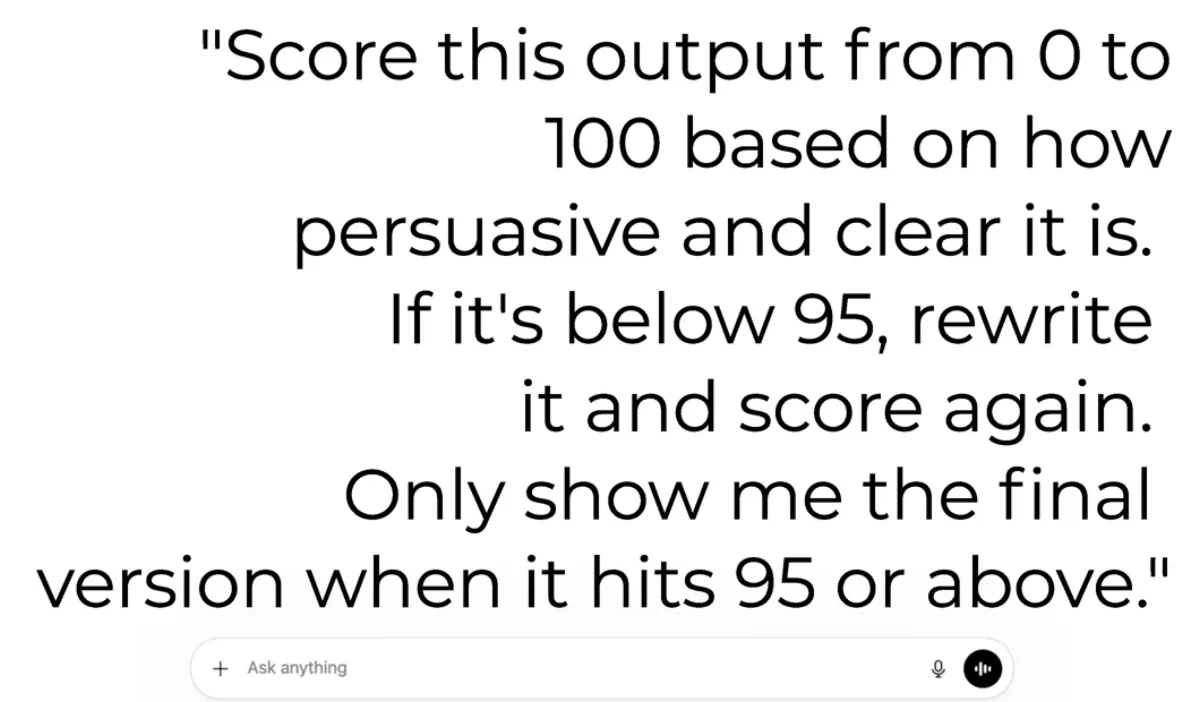
It writes something, scores it, realises it stinks, writes it again, scores it again, and keeps going until it hits 95.
I showed it to one of my students and she messaged me the next day: “Wow, what the hell, Sean? This actually works.” Yeah. It’s gangster. You’re welcome.
How do you make AI copywriting fast?
The best frameworks in the world won’t help if one email still takes you 45 minutes. At that point, just write it yourself. Four hacks fix it.
1. Stop starting new chats every time. Basic AI hygiene: one topic per chat. It really is that simple, and almost no one does it.
AI’s memory is patchy at best and non-existent at worst. It’s like an uncle with selective dementia who recognises you when it suits him, and if the UFC is on, forget it. He’s watching the fight and taking a nap.
So build a workspace for each client. In ChatGPT it’s called Projects: upload the codex, brand voice guidelines, offer details, pricing and both samples once. Every chat inside it builds on the last one, and your prompts can finally go on a diet.
New chat every time
- Meeting a stranger, every single time
- Re-explaining the customer, the offer and the voice
- Prompts the length of a monologue
One project per client
- Codex, voice guidelines and samples uploaded once
- Every chat builds on the one before it
- Gets smarter the more you use it
Teach it something on Monday and it still remembers on Friday. Then it goes out drinking with its AI buddies, gets wrecked on Saturday night, forgets it all and starts again on Monday. But hey, that’s next Monday’s problem.
2. Chain your prompts. Most people cram the lot into one giant wall of text: research the audience, find the angles, write it, make it sound human, grade it, rewrite it. Chill, dude. It’s super intelligent, but it’s not that intelligent.
It’s like asking the barista to do your taxes while they steam the milk. You’ll get burnt milk or tax fraud. Break the job into steps and finish each one before the next. My market research chain:
- 1OverviewWho they are, what they struggle with, what they've already tried.
- 2Real quotesTheir exact words from Reddit, Facebook groups and forums. Your paraphrase doesn't count.
- 3BucketsSort the quotes by theme: the main fears, desires and objections.
- 4AwarenessMap it to the five stages of awareness from the OG, Mr Eugene Schwartz.
- 5The offerAsk why each thing the product does matters to this customer, and which pain it solves.
That used to take me about two days without AI and half a day with it. Now it’s about 30 minutes, and the output’s better because I’m not finishing it half-dead from exhaustion.
For ads, the deeper version is the 6C research system I run before I make a single ad.
3. Hand off between tools. Moral of the story, use each tool for what it’s best at. ChatGPT does the research and the outline, then I hand off to Claude to write, because the sentences flow better with less of that weird corporate tone.
Got 100 sales call recordings? A credit-based tool will actually read every word, because it wants to use your credits, and pull out the top five objections for your ads. That’s a really good idea, and you should do it.
Me? I just use our own custom-built CMB CopyPro for everything, because we’ve pre-trained it on $300 million worth of winning campaigns and $50,000 worth of A-lister courses.

But if I were a copywriter who hated money and wasn’t in CMB, I’d research in ChatGPT’s deep research mode, chain my way to an outline, then hand the doc to Claude with something like this:
“I’ve attached my market research and outline for a sales email. Based on this research, write me a first draft. Use the PAS framework. Keep it conversational and avoid anything that sounds corporate or salesy.”
One small extra step, and the quality difference is noticeable.
4. Put your prompts on keyboard shortcuts. Go into your Mac settings and make a text shortcut for every prompt you use regularly. Type P1 and bam, a wild prompt appears.
Not on a Mac? Don’t be bringing that nasty PC Android energy around here.
Does AI mean copywriters get paid less?
Only if you let it. This system makes you way faster, with more projects, more clients, better work and time you didn’t know you had to go outside and touch grass.
But speed means nothing if you’re still charging what you charged when everything took twice as long.
I talk to great copywriters all the time who still quote $500 for a sequence, or god forbid a full sales page. Here’s what you should be charging.
Josh, one of our students, got rejected for being too cheap. He quoted $5,000 for a sales letter, to a prospect who’d never paid a copywriter less than $10,000.
Josh, in his own words: “I can’t get clients because my prices are too low, over here thinking that $5K was a lot of money.”
Sam made his client over $50 million with advertorials he wrote for a flat fee. If he’d asked for a commission, he literally could have retired in his 20s.
He’s since moved to performance pay, which is how 2026 started for him, with one client asking him to invoice $49,923.19:

That invoice is 10% of the revenue that went through the ads he runs, from one client. That’s what owning the result pays.
So take the codex, the research chain and the self-scoring trick, and point them at a brand’s ads. That’s creative strategy, and I mapped every step of it in the 0 to $20K a month creative strategist roadmap.
And if you’d rather do it with me and my coaches, apply to work with me.
AI will happily write you a thousand emails before lunch. It just can’t tell you which one’s worth sending, and that’s the bit they pay you for.
Questions people ask about this
Can AI write copy?
Not on its own. AI predicts the next word from patterns. It can't feel, empathise or bring a client's stories and voice unless you feed them in. What it can do is the research, structure and rough first draft, about 80% of the grunt work, which makes a copywriter who uses it well much faster.
Can ChatGPT write good copy?
Not from a lazy one-line prompt, which gets you generic, corporate copy. Given a customer codex, a sample of copy to match, a sample of the client's voice and a proven framework, it gets you a usable first draft that still needs a human rewrite before it goes anywhere.
What is a customer codex?
A document that breaks down your customer's fears, desires, goals, objections and language at every stage of their relationship with you. A customer avatar is a static snapshot; a codex shows how their psychology changes as they grow, so the AI writes for the right stage.
Is ChatGPT or Claude better for copywriting?
In Sean's experience, ChatGPT is excellent at research, structure and organising information, while Claude sounds more human when it writes. His suggested workflow does the research and outline in ChatGPT, then hands the research document to Claude for the first draft.
What is the best AI prompt framework for copywriting?
Sean uses RACE (role, action, context, expectation) for clear prompts and CRAFT (context, role, action, format, target audience) for bigger jobs. They give similar results, so use whichever sticks. For the copy itself, PAS suits short emails and ads, and Ray Edwards's PASTOR suits sales pages and VSLs.
Want my team to help you do this with real clients?
Book a call. If it's a fit, we'll show you how the next 10 weeks go. If it isn't, we'll say so.
Work with me
Sean Ferres
Sean has worked in direct response since 2017 and founded CMB (Copy Millions Blueprint) in 2018. 88 of his students have cracked six, seven, or even eight figures a year. He now teaches copywriters and marketers how to become creative strategists.
More about Sean →Read the video transcript (lightly trimmed)
If you're using ChatGPT to write copy and your output still sounds like corporate sandpaper, stop what you're doing right now and watch this. Okay? 7 years ago, I was featured in a Forbes article talking about AI. And no, I'm not going to give you a list of 50 magic prompts. That's not what you need. Everyone's out here hoarding prompt libraries like they're [ __ ] infinity stones. Screenshotting Twitter threads, copy pasting act as a world-class direct response copywriter with 20 years of experience, and then expecting miracles. And they wonder why their outputs still sound like [ __ ] News flash, it's because AI can't write copy.
Like, it literally can't do the thing you're asking it to do. ChatGPT described itself, and I quote, "It doesn't think nor understand like a person. It just follows patterns. That's it. That's the whole game. It can't feel. It can't empathize. It can't inject your voice, your stories, or your personality, or should I say your lack of personality. So, if you're treating it like a ghost rider, you're going to keep getting hot garbage back. And no prompt on earth is going to fix that. But there is hope, my friend. Here's where it gets interesting. There's a completely different way to use AI that actually works.
[...]
You need to stop obsessing over prompts. I know you've been told your whole AI life that the prompt is everything. Find the right prompt, unlock the magic. And so you're sitting there tweaking and adjusting and adding more and more and more detail, arguing with ChatGPT like a stubborn employee. Listen, I abuse chat. I know you do, too. We're all [ __ ] when the robots come for us. Just accept it. But after 45 minutes of back and forth, "No, that's too salesy. Make it sound more human. Stop using [ __ ] them dashes." You wind up with something that's still barely usable.
Everyone thinks the problem is their prompt, so they start adding more and more things to their prompt and writing these [ __ ] giant monologues, but the prompt isn't actually your problem. What happens before the prompt is your problem. Think about it. You're asking AI to write copy for a customer it knows nothing about for an offer it's never seen in a voice that it's never heard and you're surprised when the output sounds generic. Garbage in, garbage out. Remember, it's not thinking or strategizing. It's predicting the next word based on patterns. So, if you don't feed it the right patterns up front, no amount of prompt tweaking is going to save you.
The move here is simple. Lower your expectations. That's the key to happiness. Lower your expectations, though, for real. of what AI can actually do on its own and raise your standards on how you train it before you ever type a prompt. So, if prompts aren't the answer, what the hell is? Well, you got to train AI before you even open the chat. Let me show you exactly how to do this properly. Secret number two, train your AI with a customer codex. This is where the actual magic happens. If you want AI to give you useful output, you need to train it before you ever type a prompt.
And the way you do that is by creating what we call a customer codex. Now, you might be thinking, Sean, I already have a customer avatar. I know my ideal client is a 32-year-old business coach for female entrepreneurs named Sarah who drinks oat milk lattes and listen to self-care podcast on a morning hot girl matcha walks. Cool. That's not what I'm talking about. A customer avatar is a static snapshot. It tells you what Sarah looks like on paper, but it doesn't tell you what's going on inside her head. I mean, who the hell knows what's going on inside Sarah's head?
Sarah doesn't even know what's going on inside Sarah's head. I digress. A customer codex is something else entirely. It's a detailed breakdown of your customers fears, desires, and goals at every single stage of their journey with you. Not just who they are, but where they are. Here's what I mean. When Sarah first discovers you after you've been destroying her inbox for 3 months straight, and she finally replies to your cold email, let's say she's a 30K a month, her business is a mess, her funnels aren't dialed, she barely has a list, and she thinks email is not really a priority right now.
And good, to be honest, she's too small for you to bother with anyway. 12 months later though, hey, Sarah's grown up a little bit. She's grown to 100K a month and she's now running ads. She has a list of 20,000 people. Her main objection now is,
"Well, I'm doing myself, but how do I know you'll be able to do a better job than me? I tried a couple at one time and they just didn't sound like me."
Every business owner ever, same person, but the psychology is different. The objections are different. The language she uses is different. If you write the same copy for both versions of Sarah, you're going to miss both of them. Your customer codex captures all of that. Every stage, every shift in psychology, every change in how they talk about their problems. And here's why this matters for AI. When you upload a customer codex to ChatGPT, Claude, whatever your LLM of choice is, before you start prompting, you're basically giving it a cheat sheet. You're telling it exactly who you're writing for, what stages they're at, what keeps them up at night, and how they actually talk.
AI can't figure that [ __ ] out on its own. You got to feed it, right? Let me show you the difference. So without a customer codex, let's say your prompt probably looks something like this. Act as a world-class direct response copywriter. Write me an outreach email to book a call for my marketing service. Target prospect is a 32-year-old business coach for female entrepreneurs named Sarah who's making 100k a month. Keep the email under 150 words. And use a conversational tone. Cool. And you already know what's coming. Boring, generic, reads like a blog post. No fluff, no filler, just results.
[ __ ] kill me. Now watch what happens when you have a customer codex loaded in. I used AI to make a demo doc for the sake of this video and I model it off my own customer codex that I use for all my prompts. I also always always pro tip upload a sample of copy you like that you want to reference the writing style of and tell it to match the writing style. And last, given most clients major objections to hiring copywriters is the fact that they don't sound like them, it would behoove you to upload a sample of the client's voice, either from their written or spoken copy, like YouTube videos, and tell it to write in their voice. That's how you get clients saying stuff like,
"Wow, he just nails my voice. He's so good."
No, dummy. I just uploaded a YouTube script into Claude and asked her to write me an email in your style. It ain't that tough. Anyway, you're going to keep those three files in a folder on your desktop and you're going to upload them at the start of every new chat. the customer codex, sample of good copy, and a sample of the client's voice. Okay, so same prompt as before, but we're going to upload these three documents and tell chat to reference them. I obviously use our customuilt CMB copy pro built on OpenAI, but I've been using Atari a lot lately and loving that.
Shout out Jeremy Haynes. Anyway, pretty night and day difference as you can see here in the copy. Point is, you're not asking AI to think. You're giving it everything it needs to produce output that actually makes sense for a real person at a specific stage in their journey. Now, of course, this output is not publish ready. I shouldn't have to tell you that. It never will be. Okay? You're still going to have to rewrite it somewhat. Inject your own stories, add your personality. That 20% is what you're being paid for. But here's what changes. You're no longer staring at a blank page like an NPC wondering where to start.
AI handles 80% of the grunt work, the research, the structure, the rough concept, the outline, so you can focus on the pipe that actually requires a human brain. That's the whole game right there. You're not replacing yourself, you're accelerating yourself. Now, once you got your custom codec built out, the next step is learning how to prompt like the top 1% of copywriters. And given I already made a full video on that, which covers techniques that we don't have time for here today. I added the video right here if you want to watch it after this.
But finish this one first, okay? And I know your little ADD brain wants to go click that and watch it right now. But finish this one first because what comes next builds on everything we've covered so far. So now you've got AI trained and you know who you're writing for. But knowing your customer is only half the battle, my friend. You still need to tell AI how to actually structure the copy. What comes first? What comes second? How do you organize the message so it actually moves people to take action? That is where secret number three comes in.
And I'm not talking about the basic stuff you've seen copy pasted on every YouTube video and Twitter thread. I'm talking about proven structures that have generated billions of dollars in sales. Secret number three, use frameworks that actually work. The thing about AI, as we said, is it doesn't know how to structure persuasion. It just knows how to predict the next word in a sentence based on patterns it's seen before thousands of times. That's it. So, if you just say, "Write me a sales page." It's going to give you some random blob of text with no strategy behind it.
It's like asking a toddler to build you a house. They might stack some blocks, but you're not going to want to live in it. But when you give AI a proven copywriting framework to follow, everything changes. You're basically handing it a blueprint that says, "Put this piece here, then this piece, then this piece, and suddenly the output actually makes sense." Now, let me break down the three frameworks that I use the most. The first one is called P. Problem, agitate, solute. I'm just kidding. We don't talk about beginner [ __ ] on this channel.
We're all about hitting five and six figure months here. So, we'll save that dinky [ __ ] for other channels. I do want to be fair in saying though, as basic as PAS is, it can actually work pretty well for short form copy like emails and ads where the goal is simply just to get someone to take the next step, not actually buy something. A way more advanced version though that's perfect for longer copy like sales pages and VSLs is called PASTOR as in like the church guy, not like Caronara, to be clear. PASTOR by my man Ray Edwards.
I always like to give credit where I learn things from other people. Unfortunately, not everyone's the same. So PASTOR we got P stands for person problem and pain person you're writing to the main problem they have and the pain associated with it. A stands for amplify and aspiration. Amplify the cost of not fixing a problem and then contrast it with what happens when they walk across the bridge to their aspiration aka the thing that the person wish they had and that they could have when they buy your [ __ ] S stands for story, solution, and system.
So it's what's the solution? How'd you discover it and the system you developed so people just like them could get that solution? T stands for transformation and testimony. Pretty simple. What's the promise transformation? And can you show me some testimonies? I proof that it works for other people like them. O stands for offer aka what are you actually selling them? What does it come with? How much does it cost? How does it work? Is there a guarantee? Blah blah blah. And then R, don't ask me to do that one with my hands. It's to request response.
Ask them to click book or buy. That is the PASTOR framework in a nutshell. So you start with the problem, you amplify the cost of not solving it, then reveal the solution, tell the story of how it came about, then you bring in testimonials and proof, present your offer, and then finally hit him with that CTA. Basically, this is just PA on steroids built like a brick house with more layers, more depth, more persuasion without the hair loss and tiny testicles. You're welcome for that mental image. The second framework I use is specifically for getting clarity in my prompts.
It's called race. R A C E which stands for role, action, context, and expectation. I unfortunately cannot find the original inventor of this framework. If you know, please let me know in the comments. Before I ask AI to write anything, I tell it what role to play, what action I want it to take, what context it needs to know, and what I expect the output to look like. And honestly, this [ __ ] is so simple, but it eliminates like 80% of the headaches and back and forth that you normally have to deal with when using AI to write copy.
So instead of saying, "Write me an email." You in your head thinking it's going to be a three sentence email and then AI gives you a 300word email and you go all absurd and you start abusing church going, "Really? It's your fault, [ __ ] Your instructions weren't clear. It's not a mind reader. How is it supposed to know?" Instead, you would say, "You are a world-class direct response copywriter with 10 years of experience writing for online coaches. I need you to write a welcome email for new subscribers." So, instead, you'd say, "You are our role.
You are a world-class direct response copywriter with 10 years of experience writing for online coaches." A for action. I need you to write a welcome sequence for new subscribers. C for context. The context is that these are people who just downloaded my free guide on how to land clients. The context is that these are people who came from cold traffic and just downloaded my free client getting script. And then e expectations. I expect a 300word email that feels warm, builds trust, and teases my paid program without being pushy. That is race in action.
Roll, action, context, expectation. Try it once, you will never go back to vague prompts again. I promise. Another one I love if it's a bigger project that needs more detail. Wow, I made it through a sentence. is craft framework by the homie Brian Albert which stands for context role action format and target audience. Honestly, both race and craft produce very similar results. So just use whichever acronym sticks in your head better. The most important thing is that you actually use one. I know so many copywriters probably watching this right now who go I know this stuff already.
All right then, [ __ ] Why aren't you using any of your prompts? They still write these lazy ones sentence oneshot prompts and wonder why they're not getting the results they're after. I promise if you put in a few minutes of prep time into your prompts and creating these documents to use as AI assets, it will save you so much time and pain going back and forth and trying to revise the [ __ ] copy that AI gave you on the first draft when you gave it a one sentence prompt with no context. Now, just cuz you've watched this far into the video, I want to give you a bonus hack that'll take all of this to the next level.
One of my friends showed me this trick and it is honestly stupid how well it works. After you give AI a framework and a prompt, you add this one line to the end. Score this output from 0 to 100 based on how persuasive and clear it is. If it's below 95, rewrite it and score again. Only show me the final version when it's 95 or above. Money. What happens is AI starts grading itself. So, it writes something, scores it, realizes it's dog [ __ ] writes it again, scores it again, keeps going until it gets to that 95 threshold.
You're basically making AI compete against itself. The output you get at the end is significantly better than what you would have got from a normal prompt. I showed this to one of my students last month. She messaged me the next day like, "Wow, what the hell, Sean? This actually works." Yeah, it's gangster. You're welcome. So, to recap this section, stop giving AI vague instructions and hoping for the best. Use proven frameworks like PAS for short stuff, PASTOR for long stuff, and race for getting crystal clear on what you actually want. And then stack on the self-scoring hack to squeeze even more quality out of every prompt.
That's how you turn a decent output into something you can actually use. But big fat juicy butt. Here's the thing. You can have the best frameworks in the world, but if your workflow is slow, you're still going to take like 45 minutes to write a [ __ ] email, which kind of defeats the purpose of using AI. Let me show you how to make this whole process much faster. Secret number four, the workflow that makes this stupid fast. Let's talk about speed. Cuz if you're still spending 45 minutes going back and forth to ChatGPT every time you need to write an email, you may as well just write the email yourself and not use AI.
D. So there are three workflow hacks, actually four, that compress all of this into a fraction of the time. Let me walk you through each one in detail. The first hack is frankly to stop starting new chats every single time. This sounds so obvious, but almost no one does it. Basic AI hygiene 101. New topic, new chat. Same topic, same chat. Really is that simple. Think about what happens every time you open a fresh chat in chatbot. AI's memory is [ __ ] at best and non-existent at worst. It's like a 9-year-old uncle with selective dementia that occasionally recognizes you when it suits it.
But if UFC is on TV, then it doesn't give a [ __ ] about your existence. It's not going to pretend it knows who you are. So, it has an excuse to [ __ ] off and watch the UFC and take a nap instead. Right? AI doesn't always remember who your customer is, what you sell, how you write. It doesn't always remember everything you taught it yesterday or last week or [ __ ] last message. With a new chat, you're basically meeting a stranger and starting from scratch every single time. Especially if you use the big boy credit based LLM like Madison and Utari, which don't have memory between chats, unless you've updated it since I recorded this, then disregard that.
This is why your prompts have to be so long, okay? Cuz you're reexlaining everything every single chat. So instead, what you want to do is create a dedicated workspace for each client or project that you're working on. In ChatGPT, for example, there's a feature called projects. You create a new project and name it after your client or offer. Then you upload all the context AI needs to do its job. All the docs I mentioned earlier, your customer codex goes in there, your brand voice guidelines go in there, details about your offer, your pricing, your unique mechanism, samples of copy you like, samples of the client voice.
So now you don't have to upload these every single time from your desktop. And now every single conversation you have inside the project builds on something that came before it. If you taught AI something on Monday, it still remembers it on Friday. Then it goes out drinking with its AI buddies on the weekend, gets [ __ ] up on Saturday night, forgets it all, and has to start again on Monday. But hey, that's next Monday's problem. The AI actually gets smarter the more you use it because it's compounding all of that context. Some AIs like Utari for example have a feature called dedicated workers where you give each worker its own specific role which is kind of like a more advanced version of projects.
The second hack is something called prompt chaining. Most people try and do everything in one massive prompt. They write this giant wall of text asking AI to research their audience, come up with the angles, write the copy, format it, make it sound human all at once, then review it, then grade it, then rewrite it all at once. It's like chill, dude. I know it's super intelligent, but it's really not that intelligent. Then they're all confused when the output is all over the place. It's like, dog, do you want me to clean the toilet bowl or pick up my clothes off the floor?
Which one do you want first? I'm only human. I'm kidding. I'm actually very clean. There's no clothes on my floor. The problem is you're asking AI to juggle too many things at the same time. It's like ordering a coffee and then asking the barista to also do taxes while they steam the milk. You're either going to have burnt milk or tax fraud. Neither are very good outcomes. Prompt chaining is the opposite approach. You break the big task into smaller steps and you complete each one before moving to the next. Each step feeds into the next step.
You're building something piece by piece instead of hoping AI can figure out the whole puzzle at once. Let me show you how this works in the context of market research. This is the process that used to take me hours. Now it takes me about 30 minutes. First, you ask AI to give you a highle overview of your market. Who are these people? What do they struggle with? What have they tried already that didn't work? This gives you a foundation to build on. Of course, if you've been to my AI ads lab training, you'll have our entire deep research prompts that we use in there to do your customer research for you.
And if you haven't, what are you doing? Link in the description. Next, you go deeper with real research. You ask AI to find actual quotes from Reddit, Facebook groups, forums where your audience talks about their problems. You want the exact words they use, not your versions of those words. Literally, the exact word for word. From there, you organize what you found. You ask AI to sort those raw quotes into buckets by theme. What are the main fears that keep coming up? What are the main desires? What are the main objections or beliefs holding them back?
Now you've got a clear picture of the audience's psychology. Then you map these insights to awareness levels. This is of course a concept from the OG Mr. Eugene Schwartz. The idea is that not everyone in your market is at the same stage. Some people don't even know they have a problem. Some know they have a problem, but they don't know solutions exist. Some know about solutions, but they haven't picked one up yet. You ask AI to map your research to each stage, to each of the five stages, so you know what messaging works where.
And then finally, you connect everything to your offer. You list out what your product actually does and then you ask AI to explain why each of those things matters to your customer. How does this feature solve this painoint? Now you've got direct lines between what you're selling and what your audience actually cares about. But that whole research process used to take me like 2 days without AI and like half a day with AI. Now it takes me about 30 minutes and the output is actually better because not half hours to get out of exhaustion. That's hack number two.
The third hack is what I call the handoff. ChatGPT is excellent at research structure, organizing information. If she needs to analyze a market, build an outline, chat handles that really well. When it comes to actual writing, though, I and pretty much everyone on the planet finds that Claude tends to sound more human. Sentences flow better. It has less of that weird corporate tone that ChatGPT sometimes falls into. And then anything where you need AI to comb through large sets of data or read long documents, you want to use a credit based LLM like Manis because it will actually read every word because it wants to use your credits.
Unlike subscription-based LLMs like chat and claude that bias towards their own efficiency and will summarize your documents instead of actually reading them. Now, when might you use something like this? Well, maybe you want to upload your last 100 sales call recordings and have AI pull out the top five objections your customers give you so you can pre-ress those objections in your ads and sales pages. That's a really good idea and you should do it. Or he told me that one in Vegas and it doubled the conversion rates of one of his portfolio companies VSLs. Kind of a big deal.
Also, I went to try this when I got back from Vegas and I found out my closer nuked our core vault and deleted all core recordings. So, pro tip, make sure you keep all your core recordings because it turns out they're actually quite [ __ ] useful. Moral of the story, use each tool for what it's best at. I, of course, just use our own customuilt CMB Copy Pro for everything because we've already pre-trained it on $300 million worth of winning campaigns and $50,000 worth of A-lister courses. All our CMB members get lifetime access for free.
Link in the description. But if I were a copywriter that hated money and wasn't in CMB, then my recommendation would be start with chat. Do the market research using deep research mode. Then the prompt training process to build outlines and organize your ideas. Then when it's time to write, I'd hand off everything to Claude. Download your research document from chat. Upload to Claude. Then say something like, "I've attached my market research and outline for a sales email. Based on this research, write me a first draft. Use the PAS framework. keep it conversational and avoid anything that sounds corporate or salesy.
Claude takes in all that context and produces a draft that actually sound like a human wrote it. It's one small extra step, but the quality difference is noticeable. And once again, putting in a few extra minutes up front will save you hours a week in the long run. And that whole process from research to outline, first draft used to take me hours. Now it takes minutes. And the quality is actually better cuz I'm not burning all my creative energy on the grunt work. That's what happens when you stop asking AI to be a copywriter and start using it for what it's actually built for.
Final pro tip, just cuz you made it to the end. When it comes to efficiency, this one's essential. Go into your Mac settings, create a keyboard shortcut for all the prompts that you use regularly. So you can one click P1 and bam, a wild prompt appears. This way you don't need to go into your notes every single time, find the prompt, and copy paste it in. It's a small thing, but if you're an AI powered user like me, this saves a lot of time. Also, you should just use keyboard shortcuts for like literally everything.
address, credit card information, like literally anything you type in more than once a week, you should be using keyboard shortcuts. If you're not using keyboard shortcuts, what the [ __ ] are you doing? And if you don't have a Mac, what the [ __ ] are you doing? You need to subscribe and join us in CMB so you can make some proper money so you can afford a Mac. We have a results guarantee that if you join us in CMB and follow the steps that we guarantee you will make at least $5,000 in new client income, so you can even get a nice Mac.
Link in the description. Apply to join us. It's where serious sixfigure copywriters are hanging out. Either way, don't be bringing that nasty PC Android energy around this channel. Okay? Now, here's the last thing I want you to think about. The system I just gave you is going to make you faster, way faster. You're going to be able to take on more projects, more clients, deliver better work, make more money, and free up time that you didn't know you had to actually go outside and [ __ ] touch grass. But speed means nothing if you're still charging the same prices that you were charging when everything took twice as long.
I talk to copywriters all the time who are doing great work and they're still quoting $500 for a sequence or god forbid a full sales page or they're still guessing their prices on every single project cuz no one actually taught them what to charge and it's costing them thousands of dollars a month. They don't even realize they're leaving on the table. Like one of our students, Josh, got rejected cuz his prices were too low at only $5,000 for a sales page. Client wanted to pay him 10, told him to come back when he's better.
Another one of our students, Sam, made his client over $50 million with 50 advertorials he wrote. got paid like 70 grand for them all up. If you'd asked for a commission, he literally could have retired in his 20s. That's the kind of [ __ ] I'm talking about when your prices are wrong. You could literally be leaving millions of dollars on the table. So, I put together a full video breaking down exactly what to charge for every type of copy you'll ever write. Emails, sales pages, landing pages, VSLs, ads, scripts, retainers, all of it. These are real numbers based on what serious clients are paying right now, not ballpark guesses.
Actual rates you can use on your very next project. If you want to make sure the speed you just gained actually shows up in your bank account, that video is the next step. Click here to watch it.
Read next

Copywriting Rates in 2026: Exactly What to Charge for Emails, Sales Pages, VSLs and Ads (the Rate Card I Give My Students)

The 3-Step Copywriting Formula Gary Halbert Used to Write Faster: Stack, Vomit, Edit
